
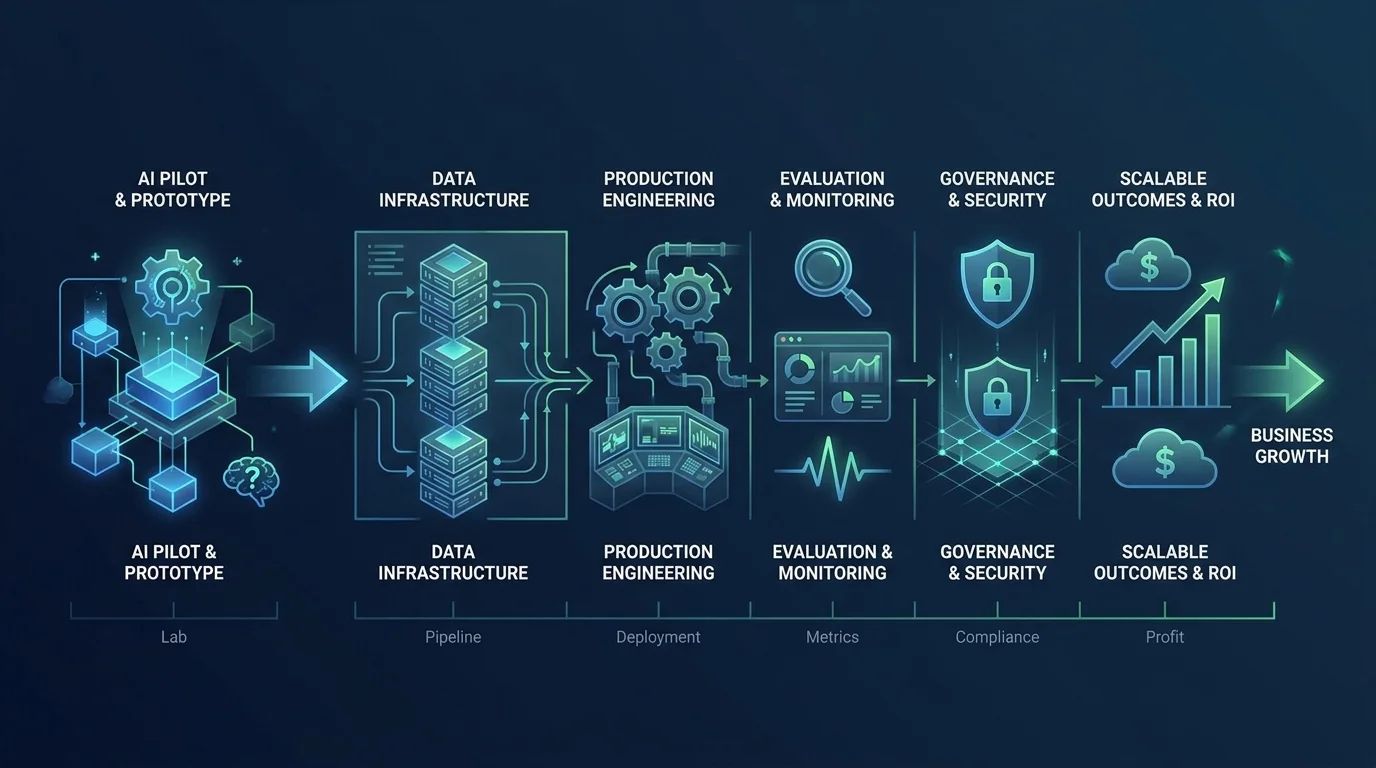
Enterprise AI has no shortage of pilots. The harder problem is turning those pilots into measurable business value.
That gap is becoming more visible in 2026. PwC reports that the top 20% of organizations in its global AI Performance Study capture 74% of AI-driven returns, while Deloitte found that only 25% of respondents had moved 40% or more of their AI pilots into production. At the same time, McKinsey’s August 2026 State of AI survey shows large enterprises are scaling AI agents more aggressively than a year ago. The message is clear: adoption is accelerating, but value is still unevenly distributed.
The difference is rarely explained by access to a better model alone. Organizations that generate value are more likely to redesign workflows, integrate AI into core operating systems, establish governance, measure outcomes, and build the production architecture required to run AI reliably at scale.
This article explains why enterprise AI pilots stall before ROI—and how engineering teams can design for production value from the beginning.
The Pilot-to-Production Gap Is Now the Real AI Problem
AI experimentation has become comparatively easy. A capable team can connect a foundation model to internal documents, build a proof-of-concept assistant, train a predictive model, or automate a narrow process in weeks.
Production is different.
A production AI system must operate inside real business constraints: imperfect data, changing workflows, permissions, compliance requirements, legacy applications, cost ceilings, reliability targets, user behavior, security boundaries, and measurable business outcomes.
Deloitte’s 2026 State of AI research highlights this gap directly: only a quarter of respondents had moved at least 40% of their AI pilots into production at the time of the survey. Meanwhile, PwC’s 2026 analysis found AI value concentrated among a relatively small group of organizations.
This suggests a useful distinction:
| AI Pilot | Production AI System |
|---|---|
| Tests technical feasibility | Delivers a repeatable business outcome |
| Uses controlled data | Operates on live, changing data |
| Small user group | Multiple roles, workflows and access levels |
| Manual supervision | Automated controls, monitoring and escalation |
| Short-lived budget | Ongoing cost and capacity management |
| Demo-quality integration | Reliable integration with enterprise systems |
| Model metrics | Business KPIs + model + operational metrics |
A pilot answers, “Can AI do this task?” Production engineering answers, “Can the business depend on it?”
Why Enterprise AI Pilots Fail to Produce ROI
1. The project starts with a model instead of a business outcome
One of the most common failure patterns is technology-first project selection. A team gains access to a new model, then searches for somewhere to use it.
That can produce impressive demonstrations without producing economic value.
A stronger starting point is a measurable business constraint: reduce inspection time, increase first-contact resolution, shorten engineering review cycles, improve forecast accuracy, reduce downtime, accelerate quote generation, or increase conversion.
The AI architecture should then be designed around the outcome—not the other way around.
This is consistent with PwC’s 2026 AI Performance Study, which found AI leaders were more likely to pursue growth and business-model reinvention rather than treating AI simply as another productivity tool.
2. AI gets layered onto a broken workflow
Adding AI to an inefficient process often produces an AI-assisted inefficient process.
For example, generating a customer-service response faster has limited value if the agent still needs to copy information across three disconnected systems, wait for manual authorization, and re-enter the same case data elsewhere.
PwC reports that leading organizations are twice as likely to redesign workflows around AI instead of merely adding AI tools to existing processes.
That distinction matters. The real unit of transformation is usually not the model—it is the workflow.
Engineering teams should map:
- where information enters the process;
- which decisions require human judgment;
- which steps can be automated safely;
- which systems must exchange data;
- where approvals are required;
- how exceptions are handled; and
- what measurable outcome the workflow produces.
3. The data and integration layer was never production-ready
Many pilots succeed because engineers manually curate the data used in the demonstration. Production systems cannot rely on that.
Real-world AI depends on dependable pipelines, access controls, source freshness, data quality, identity, APIs, event flows, retrieval logic, and system-of-record integration.
An enterprise assistant that gives an excellent answer but cannot access the latest customer status is unreliable. A predictive-maintenance model that cannot consistently ingest sensor data is not operational. An AI agent that cannot safely authenticate to business tools cannot become autonomous.
This is why production AI engineering extends well beyond model development. NiDA AI’s own AI engineering services emphasize the full lifecycle from data engineering and model development to deployment and production scaling, while its machine learning engineering work includes data pipelines, API integration and monitoring.
4. Teams measure model quality but not business value
A model can score well on an evaluation dataset and still fail commercially.
Accuracy, precision, recall, groundedness and response quality remain important, but they are only one layer of measurement.
A production system should have three linked scorecards:
| Layer | Example Metrics |
|---|---|
| Business | Revenue lift, cost per transaction, downtime avoided, cycle time, conversion, service resolution |
| AI quality | Accuracy, task success, groundedness, tool-call correctness, safety, drift |
| Operations | Latency, availability, error rate, throughput, inference cost, escalation rate |
If those layers are not connected, a team may successfully optimize a model while the underlying business case deteriorates.
5. Evaluation ends when the pilot ends
Traditional software is expected to be deterministic enough that the same code path produces predictable behavior. AI systems add statistical and contextual variability.
That makes continuous evaluation and monitoring essential.
NIST’s 2026 work on monitoring deployed AI systems emphasizes that post-deployment monitoring is crucial because AI can exhibit unpredictable behavior in real-world environments. Microsoft similarly describes production observability as a combination of evaluation, monitoring and tracing across the AI lifecycle.
Production teams should be able to answer:
- Is task success improving or degrading?
- Which inputs cause failures?
- Are retrieval sources still current?
- Are users overriding the system frequently?
- Has cost per successful task increased?
- Are certain tools or integrations causing errors?
- Is performance drifting after data or model changes?
Without this feedback loop, teams discover problems through user complaints instead of operational telemetry.
6. AI economics are treated as an afterthought
A pilot may process a few hundred requests. A production system may process millions.
The economics change quickly.
McKinsey’s July 2026 research on enterprise AI cost management found that AI spending can rise sharply as organizations scale and that many enterprises lack visibility into fragmented AI costs.
Production architecture therefore needs an explicit cost model that considers:
- model selection and routing;
- input and output token volume;
- retrieval size;
- agent loop depth;
- tool calls;
- caching;
- batching;
- inference infrastructure;
- observability overhead; and
- human review costs.
The cheapest model is not automatically the most economical system. The correct target is cost per successful business outcome.
7. Ownership becomes unclear after the demo
Pilots are often championed by innovation teams. Production systems need ongoing owners.
Who owns the workflow? Who owns model quality? Who approves data access? Who responds when performance drops? Who controls the budget? Who decides whether a new model should replace the current one?
If those questions are unanswered, the project has a technical prototype but no operating model.
The NidaAI Production Value Framework
A practical way to avoid the pilot trap is to design AI around seven production layers from the beginning.
Layer 1: Outcome
Define the business result and baseline before building. If the team cannot express the target in operational or financial terms, the project is not ready for ROI measurement.
Layer 2: Workflow
Redesign the end-to-end process around the outcome. Decide what AI performs, what software performs, what people approve, and how exceptions move through the workflow.
Layer 3: Data and Integration
Build reliable connections to systems of record, data pipelines, knowledge sources, sensors, APIs and identity infrastructure. Avoid manual demo-only data paths.
Layer 4: Intelligence
Select the right AI technique for each part of the system: machine learning, computer vision, retrieval, language models, rules, optimization, or a combination. Do not use a frontier model where deterministic software or a smaller model is sufficient.
Layer 5: Evaluation and Observability
Create pre-production test sets, quality thresholds, tracing, cost telemetry, alerts and post-production evaluation. Every deployment should make failures easier to see, not harder.
Layer 6: Governance and Human Control
Define permissions, escalation paths, auditability, security policies and human approval points according to the risk of the action being automated.
Layer 7: Economics and Scaling
Measure cost per successful outcome, capacity, reliability and business impact. Scale only when the system can sustain both technical and economic performance.
Together, these layers turn an AI experiment into an engineered business system.
How to Move an AI Pilot Into Production: A Practical Roadmap
Phase 1: Revalidate the business case
Before investing in productionization, measure the pilot against the original problem. Establish a baseline, expected improvement, implementation cost and business owner.
Phase 2: Convert the demo into a system architecture
Document data sources, models, APIs, integration boundaries, human approvals, storage, identity, monitoring and failure handling. Identify every manual shortcut used during the pilot.
Phase 3: Build production evaluation
Create representative test datasets and define acceptance thresholds. For generative or agentic systems, include task completion, groundedness, tool-use accuracy, safety and failure scenarios—not only response quality.
Phase 4: Instrument the system
Add logs, traces, latency measurements, model usage, cost telemetry, user feedback and business KPI tracking before broad rollout.
Phase 5: Roll out to a controlled production group
Start with a real workflow and real users, but constrain scope. Compare business outcomes against the pre-AI baseline and capture failure patterns.
Phase 6: Optimize the economics
Use actual production traffic to refine model routing, caching, retrieval size, automation boundaries and human-review thresholds.
Phase 7: Scale by workflow, not by hype
Expand when the system demonstrates a repeatable advantage. The goal is not the largest number of AI projects. It is the largest portfolio of AI systems that create dependable value.
Executive Checklist: Is Your AI Pilot Ready for Production?
- Business outcome: Is there a defined KPI, baseline and accountable business owner?
- Workflow: Have you redesigned the end-to-end process rather than simply added AI to an existing task?
- Data: Are production data sources reliable, current, permissioned and connected?
- Integration: Are APIs, identity, systems of record and exception paths production-ready?
- Evaluation: Do you have representative test cases, acceptance thresholds and failure scenarios?
- Observability: Can you monitor quality, latency, cost, drift, tool failures and user escalation?
- Governance: Are permissions, security boundaries, audit logs and human approvals defined?
- Economics: Do you know the cost per successful business outcome at expected scale?
- Ownership: Is there a named team responsible for operations, model changes and incident response?
- Scale decision: Has the pilot demonstrated enough repeatable value to justify broader deployment?
If several of these answers are still unclear, the next investment should usually be production engineering and validation—not a wider rollout.
What High-ROI AI Programs Do Differently
Current research increasingly points to the same pattern. Strong performers do not simply deploy more AI tools. They redesign how the business operates.
PwC’s August 2026 intelligent-enterprise blueprint argues that AI creates value when organizations redesign workflows, decisions and accountability around outcomes. McKinsey’s latest work similarly emphasizes that AI’s economic gains can come from faster and better decisions, improved use of existing assets, and opportunities that would otherwise be missed.
That implies a different executive question.
Instead of asking:
“Where can we add AI?”
ask:
“Which business decision, workflow or product experience would create materially more value if intelligence were embedded into it?”
That question naturally leads toward architecture, integration, governance and measurement—and away from isolated demos.
Where an AI Engineering Partner Adds Value
Moving from pilot to production often requires capabilities spread across several disciplines:
- AI and machine learning engineering;
- data engineering;
- cloud or edge infrastructure;
- API and enterprise-system integration;
- security and identity;
- backend and application engineering;
- testing and validation;
- observability and MLOps;
- embedded or hardware integration where applicable; and
- product and workflow design.
This is why production AI increasingly resembles product engineering rather than a standalone data-science exercise.
NiDA AI’s product engineering approach spans requirement analysis, architecture design, engineering, testing and validation, deployment and maintenance. That lifecycle is particularly relevant for organizations trying to move an AI prototype into a secure, scalable, market-ready system.
If your team is still at the concept stage, our existing guide on turning an AI idea into a market-ready product provides a useful starting point.
Frequently Asked Questions
Why do so many enterprise AI pilots fail?
Many pilots demonstrate that an AI capability works technically but do not address production data, integrations, workflow redesign, monitoring, governance, economics or organizational ownership. Those gaps become blockers when the system must operate reliably at scale.
How should AI ROI be measured?
Measure both the business outcome and the full cost of delivering it. Depending on the use case, useful metrics may include revenue lift, cycle-time reduction, cost per transaction, downtime avoided, conversion, error reduction or service-resolution improvements. Model and infrastructure metrics should support those business KPIs rather than replace them.
What is the difference between an AI pilot and a production AI system?
A pilot validates feasibility in a controlled setting. A production AI system must integrate with real workflows, handle live data and edge cases, meet reliability and security requirements, support monitoring, control costs and deliver a repeatable business outcome.
When should an AI pilot be stopped instead of scaled?
Stop or redesign the project when the business outcome is unclear, the production economics are unfavorable, required data cannot be made reliable, the workflow does not support safe automation, or evaluation shows that the system cannot meet quality thresholds consistently.
How can companies move AI pilots into production faster?
Start production planning during the pilot. Define business KPIs, integration requirements, evaluation datasets, security boundaries, ownership and cost assumptions early. This reduces the amount of engineering that must be rebuilt after the proof of concept.
From AI Experimentation to Production Value
Enterprise AI is entering a more disciplined phase. The question is no longer whether organizations can build AI pilots. Most can.
The competitive difference is whether they can engineer AI into dependable systems that improve decisions, workflows, products and operations at a sustainable cost.
That requires more than a capable model. It requires outcome design, workflow engineering, production data, integration, evaluation, observability, governance and economic control.
If your organization has an AI prototype that needs to become a production-ready system—or a business process that could benefit from AI but needs the right architecture—talk to the NiDA AI engineering team. We help organizations move from AI concepts and experiments to scalable systems designed around real business outcomes.
