
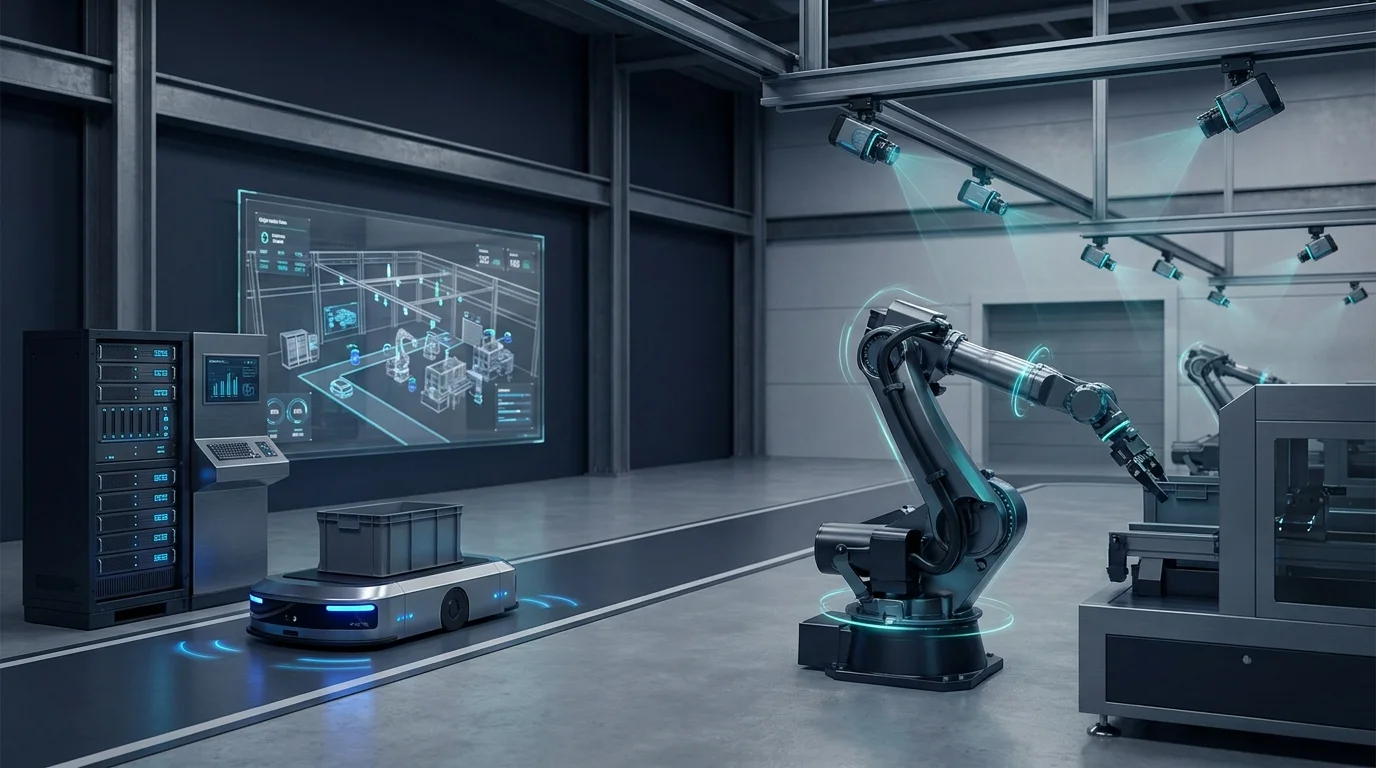
Physical AI is moving artificial intelligence out of dashboards and chat interfaces and into machines that can perceive, reason and act in the real world.
For manufacturers, that shift matters because the next wave of industrial AI is not only about predicting failure or analyzing production data. It is increasingly about connecting computer vision, robotics, digital twins, edge computing and AI agents into systems that can understand factory conditions and respond in real time.
Momentum is building quickly. Deloitte reported in March 2026 that only 3% of surveyed organizations had physical AI extensively integrated into operations, but 18% expected to reach that level within two years. NVIDIA, Siemens, ABB and Qualcomm are simultaneously expanding platforms that combine simulation, synthetic data, industrial robotics and edge inference. The opportunity is significant—but so is the gap between impressive demonstrations and reliable production deployment.
This article explains what physical AI means in manufacturing, where it creates value, the architecture required to deploy it, and the engineering challenges that determine whether a system becomes a production asset or remains a pilot.
What Is Physical AI in Manufacturing?
Physical AI refers to intelligent systems that connect AI models with physical machines, sensors, robots and industrial environments. Unlike conventional software-only AI, physical AI must interpret the state of the real world and then influence it through an actuator, robot, machine controller or human workflow.
In manufacturing, that can include:
- robots that adapt their motion using visual perception;
- computer vision systems that inspect products and trigger downstream actions;
- autonomous mobile robots that navigate dynamic factory environments;
- AI agents that coordinate machines, production schedules or maintenance workflows;
- digital twins that simulate process changes before they are applied physically; and
- edge AI systems that make low-latency decisions near machines instead of depending on the cloud.
The key distinction is that physical AI closes the loop between perception and action.
| Traditional Industrial AI | Physical AI |
|---|---|
| Analyzes data | Analyzes data and influences physical behavior |
| Often cloud-centric | Frequently edge or hybrid |
| Produces recommendations | Can execute or coordinate actions |
| Model-centric | System-centric: model + sensors + compute + control |
| Limited real-world interaction | Continuous interaction with machines and environments |
Why Physical AI Is Accelerating Now
1. Vision models are becoming practical at the edge
Computer vision is one of the strongest foundations for physical AI because machines need perception before they can act intelligently.
Modern edge processors can run object detection, segmentation, tracking and anomaly detection close to the camera or machine. This reduces latency, limits bandwidth requirements and allows systems to continue operating when cloud connectivity is unreliable.
Qualcomm’s August 2026 industrial-edge guidance highlights faster decisions, predictable costs, privacy and operational autonomy as major reasons manufacturers are moving AI closer to equipment.
NiDA AI’s computer vision engineering already spans real-time inspection, video analytics and edge deployment, making vision a natural entry point into broader physical AI systems.
2. Digital twins are reducing the cost of real-world experimentation
Training or validating intelligent physical systems directly on production equipment can be expensive, slow and risky. Digital twins provide an alternative: simulate the machine, process or factory before applying changes in the real world.
Siemens’ 2026 Digital Twin Composer work demonstrates how real-world engineering data, simulation and AI can be combined to test changes virtually. Siemens reported that an initial PepsiCo deployment identified up to 90% of potential issues before physical modification and delivered a 20% throughput improvement.
For physical AI, this enables a powerful development loop:
- model the environment;
- simulate the task;
- generate or augment training data;
- evaluate behavior virtually;
- deploy to real equipment;
- capture production feedback; and
- feed that data back into the simulation.
3. Synthetic data is addressing real-world data scarcity
Manufacturing datasets are often difficult to collect because failures are rare, production lines cannot be interrupted easily, and some scenarios are unsafe to reproduce intentionally.
Synthetic data allows teams to generate large variations of product position, lighting, defects, robot poses, obstacles and operating conditions without waiting for every scenario to occur naturally.
ABB and NVIDIA are applying this approach to industrial robotics. ABB’s March 2026 announcement describes a Foxconn pilot that trains assembly robots virtually before moving them onto the production line.
4. AI agents are beginning to interact with machines
The idea of an AI agent controlling physical equipment is becoming more concrete. Qualcomm has demonstrated edge-deployed foundation models coordinating industrial robot behavior, while recent industry work is extending agent interfaces from software tools into programmable hardware.
This creates a new manufacturing architecture where an AI agent can understand an operational objective, inspect system state, call approved machine functions and escalate exceptions to a human operator.
However, physical actions introduce much higher consequences than digital actions. Permissions, safe operating envelopes, deterministic fallbacks and human override become mandatory engineering requirements.
Where Physical AI Creates Manufacturing Value
Adaptive robotic automation
Traditional robots work extremely well when tasks and environments are fixed. Physical AI becomes valuable when variation increases.
A vision-guided robot can identify parts that are not perfectly aligned, adjust grasping or placement, detect a failed operation and adapt without requiring every possible state to be explicitly programmed.
This is particularly useful in electronics assembly, mixed-product lines, packaging and flexible manufacturing environments.
AI-powered quality inspection
Quality inspection is one of the most commercially practical physical AI applications.
A production vision system can inspect each item, classify defects, estimate severity and then interact with a PLC, robot or conveyor to reject, rework or route the product.
The intelligence is not just in detection. The value comes from the complete closed loop:
Camera → Vision AI → Decision → PLC/Robot → Physical Action → Traceability
NiDA AI’s machine learning work includes industrial fault detection and predictive analytics, while its vision engineering covers smart inspection and edge processing. Combining those capabilities enables systems that detect defects and act on them in production.
Predictive and autonomous maintenance
Predictive maintenance typically starts by estimating the probability of failure from vibration, temperature, current, acoustics or process data.
Physical AI extends the concept. A system may automatically inspect a machine, compare sensor signals against historical behavior, identify the likely fault, schedule a maintenance window, reduce machine load, or instruct a robot or technician on the next action.
Autonomous material movement
Factories increasingly use autonomous mobile robots and intelligent logistics systems to transport materials.
Physical AI improves these systems by combining perception, localization, planning and fleet-level optimization. The challenge is not only getting a robot from point A to point B—it is coordinating movement safely alongside workers, forklifts, dynamic obstacles and changing production priorities.
Production optimization through digital twins
Not every physical AI action needs to control a robot directly. Digital twins can continuously compare physical operations with simulated alternatives and recommend or automatically execute better configurations.
This can support line balancing, energy optimization, layout changes, throughput improvement and capacity planning.
The Production Architecture of Physical AI
Physical AI should be viewed as an engineered stack rather than a single model.
Layer 1: Sensors and perception
Cameras, thermal sensors, microphones, vibration sensors, encoders, LiDAR and machine telemetry provide the system’s view of the physical world.
Sensor selection must be driven by the task, required accuracy, environmental conditions and latency constraints.
Layer 2: Edge compute
Industrial edge processors run perception and decision logic close to the machine.
Edge deployment is particularly important when:
- latency must be measured in milliseconds;
- large video streams would be expensive to send to the cloud;
- data must remain within the facility;
- connectivity cannot be guaranteed; or
- the system must continue functioning independently.
NiDA AI combines AI with embedded hardware engineering and firmware development, which is important because physical AI performance is often constrained as much by hardware, drivers and real-time integration as by the model itself.
Layer 3: Intelligence
This layer may include computer vision models, predictive models, planners, language models, optimization algorithms or agentic decision systems.
The right approach is usually hybrid. Deterministic control should remain deterministic where possible, while AI handles perception, uncertainty, prediction and high-level reasoning.
Layer 4: Industrial integration
AI must communicate with the operational environment through PLCs, robot controllers, MES, SCADA, historians, APIs or industrial protocols.
This is where many demonstrations fail. A model can perform well independently but still be unusable if the surrounding software cannot handle retries, permissions, timing, failover and machine-state synchronization.
Layer 5: Safety and control
Physical AI requires clearly bounded authority.
A production design should define:
- which actions AI may execute directly;
- which actions require human approval;
- safe operating limits;
- emergency stop and manual override behavior;
- fallback rules when confidence is low;
- audit logs for machine actions; and
- cybersecurity boundaries between IT and OT systems.
Layer 6: Monitoring and lifecycle management
Real-world environments change. Cameras shift, lighting varies, equipment wears, products change and operators modify processes.
Monitoring should therefore track not only uptime but also model confidence, false positives, missed detections, latency, drift, system overrides and business outcomes.
Physical AI Is Not the Same as Humanoid Robotics
One of the biggest misconceptions is that physical AI means humanoid robots.
Humanoids are one possible embodiment, but many near-term manufacturing opportunities are better served by conventional industrial robots, cobots, fixed cameras, autonomous mobile robots and intelligent machine controllers.
Recent reporting on humanoid deployment shows why this distinction matters: hardware demonstrations can be impressive while factory reliability, dexterity, precision and economics remain challenging.
Manufacturers should therefore start from the task rather than the form factor.
| Task | Likely Physical AI Platform |
|---|---|
| Visual quality inspection | Camera + edge AI + PLC |
| Flexible pick-and-place | Robot arm + vision + AI |
| Material transport | AMR + perception + planning |
| Production simulation | Digital twin + optimization |
| Operator assistance | AI agent + industrial data + approval workflow |
| Highly variable manual-like tasks | Potential humanoid or versatile robot |
The Biggest Engineering Challenges
The sim-to-real gap
A system that performs perfectly in simulation can fail when exposed to reflections, dust, vibration, tolerance variation, sensor noise or unexpected human behavior.
Production validation must therefore include real-world data and controlled deployment, not simulation alone.
Latency and determinism
Cloud AI may tolerate seconds of latency. Machine control often cannot.
Teams must decide which functions belong on the edge, which can run centrally and which need deterministic controllers rather than probabilistic AI.
Data collection
Robotics and physical systems require diverse training data that captures environment and behavior, not just static images.
Building the right data pipeline—including synthetic data, production feedback and continuous labeling—is often one of the largest parts of the engineering effort.
Safety and cybersecurity
As AI receives more authority over physical equipment, the attack surface and operational consequences increase.
Identity, authentication, permission boundaries, network segmentation and safe-state behavior must be designed from the beginning.
ROI and maintainability
A sophisticated robotic system has little value if it requires constant specialist intervention.
Manufacturers should measure:
- cycle time improvement;
- defect reduction;
- downtime avoided;
- labor hours redirected;
- changeover time;
- throughput gain;
- maintenance effort; and
- total cost per production outcome.
A Practical Roadmap for Manufacturers
Step 1: Select a bounded, measurable use case
Start with one task where physical AI can improve an operational KPI. Avoid starting with a broad goal such as “build an autonomous factory.”
Step 2: Define the physical operating envelope
Document machine states, environmental conditions, product variation, safety constraints, expected edge cases and intervention procedures.
Step 3: Build the perception and data layer
Validate sensors and collect representative data before optimizing sophisticated models.
Step 4: Create the simulation and test environment
Use digital twins or controlled test rigs where appropriate to generate scenarios and validate behavior safely.
Step 5: Integrate with industrial systems
Connect the AI system to real controllers, applications and workflow logic early rather than leaving integration until the end.
Step 6: Deploy with bounded authority
Begin with recommendation mode or human approval for higher-risk actions, then expand autonomy only after performance is proven.
Step 7: Measure production value
Track business KPIs alongside model and system metrics. Scale only when the physical AI system demonstrates repeatable operational value.
Why Physical AI Fits the Future of Product Engineering
Physical AI sits at the intersection of disciplines that have historically been engineered separately:
- AI and machine learning;
- computer vision;
- embedded hardware;
- firmware;
- robotics;
- industrial software;
- cloud and edge infrastructure; and
- product engineering.
That makes it difficult to build successfully as a model-only project.
NiDA AI’s product engineering services combine AI, embedded systems, hardware, firmware and digital engineering across the product lifecycle. That multidisciplinary approach is particularly relevant for physical AI, where model performance and physical-system engineering have to work together.
Frequently Asked Questions
What is physical AI?
Physical AI is the use of AI in systems that perceive and interact with the physical world. In manufacturing, examples include intelligent robots, vision-guided automation, autonomous mobile robots, smart machines and digital-twin-driven control systems.
Is physical AI the same as robotics?
No. Robotics is one important component, but physical AI also includes computer vision, sensors, digital twins, edge computing, AI agents and industrial control integration.
Why is edge AI important for physical AI?
Physical systems often require low latency, local autonomy and privacy. Running AI near the machine reduces dependence on network connectivity and can make real-time decisions more practical.
Do manufacturers need humanoid robots to adopt physical AI?
No. Many high-value physical AI use cases can be implemented with cameras, industrial robot arms, cobots, AMRs and existing machines enhanced with AI.
What is the best first physical AI use case?
Quality inspection, vision-guided automation, predictive maintenance and material handling are often strong starting points because they have measurable operational KPIs and can be introduced incrementally.
From Automated Machines to Intelligent Physical Systems
The next stage of industrial AI is not simply adding intelligence to factory software. It is connecting intelligence directly to the physical systems that produce, inspect, move and maintain real products.
Physical AI will not arrive as a single technology or a sudden replacement for existing automation. It will emerge through layered improvements: better perception, smarter edge computing, more realistic simulation, adaptive robotics and tightly controlled AI agents.
Manufacturers that approach this as an engineering problem—not a robotics demonstration—will be better positioned to turn physical AI into measurable productivity, quality and flexibility gains.
If your organization is exploring vision-guided automation, edge AI, intelligent inspection, embedded AI or a broader physical AI product, talk to the NiDA AI engineering team. We help design and build AI systems that connect software intelligence with real-world products and industrial environments.
Sources and Further Reading
- Deloitte — Physical AI: The Moment of Acceleration
- Deloitte & NVIDIA — Physical AI for Industrial Transformation
- NVIDIA — Physical AI and Robotics Ecosystem
- ABB Robotics & NVIDIA — Industrial-Grade Physical AI
- Siemens — Industrial AI and Digital Twin Composer
- Qualcomm — Edge AI and the Industrial Revolution
- International Federation of Robotics — Impact of Robots
